26:51
TRACK: 1
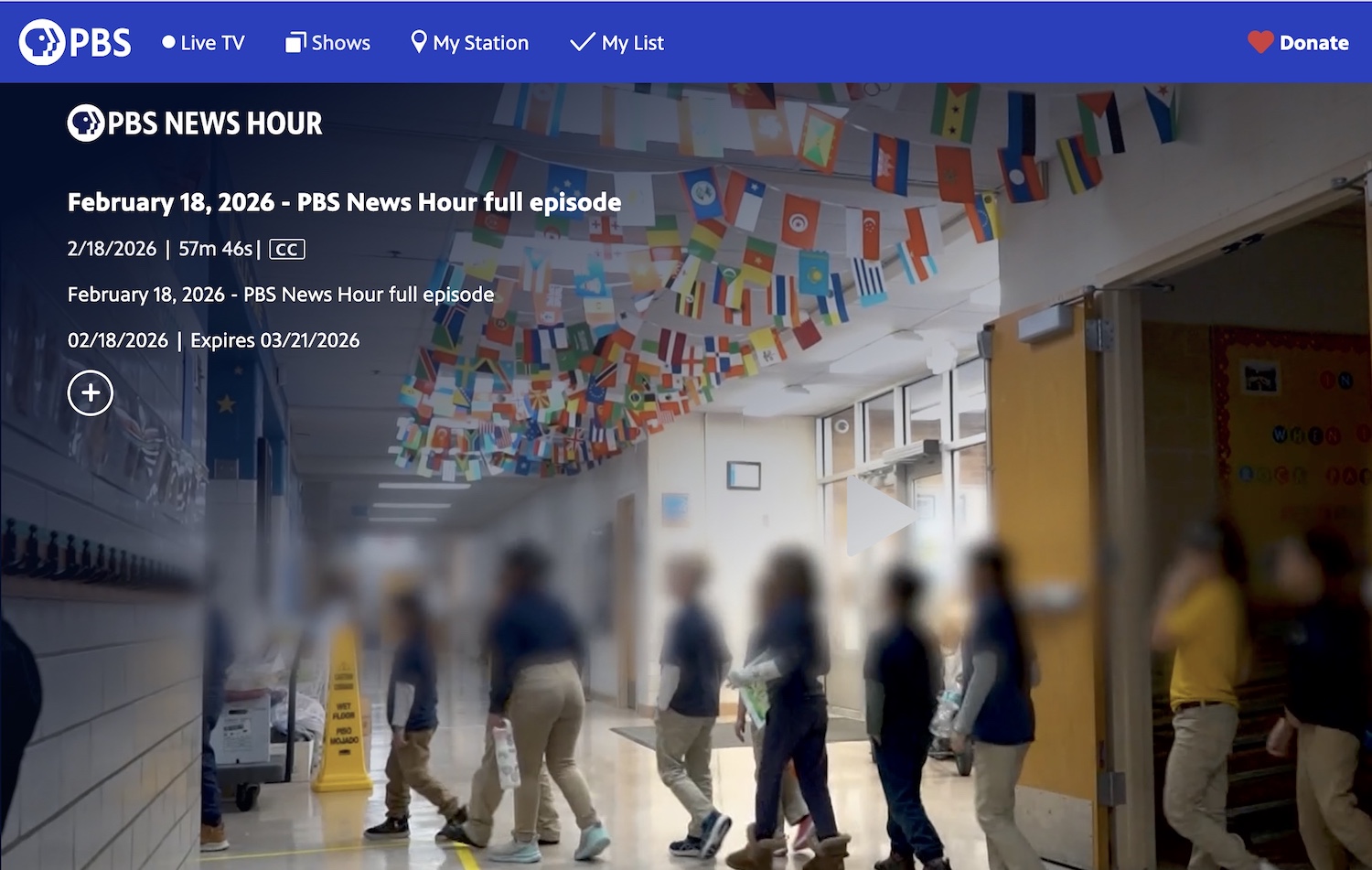
Many of the sites at Valley View Elementary are entirely familiar, young students shuffling single file through the halls, vocabulary lessons in colorful classrooms, and footraces at recess when the temperature climbs above freezing.
But all around, there are reminders of just how unusual the past several weeks have been, an entryway filled with donated food, a parking lot where community volunteers pick up students for parents unable to venture out, and classrooms that have seen up to one-fifth fewer students than normal.
SOT
JASON KUHLMAN, Principal, Valley View Elementary:
I think we try to minimize it, but I think the trauma is already there.
TRACK: 2
Jason Kuhlman is the principal at Valley View.
Four of his students were detained during Operation Metro Surge.
And he says there’s been a near constant presence of ICE in neighborhoods around the school.
SOT
JASON KUHLMAN: I think the hardest thing is the helplessness.
We can’t stop an abduction.
We can’t stop ICE taking people.
What we have to do is pick up the pieces.
TRACK: 3
Valley View, a majority-Hispanic school in the immigrant heavy Minneapolis suburb of Columbia Heights, began offering a virtual option in late January for families too scared to send their kids in person.
About 70 students are still learning remotely.
SOT
JASON KUHLMAN:
Our kids start looking and they start seeing those empty chairs and it’s consistent, and you see our staff start getting anxious because they know what happened.
And that’s where it hits.
TRACK: 4
One of those empty chairs belongs to 5-year-old Liam Conejo Ramos.
His story gained international attention last month when he and his father were detained by federal agents on their way home from school.
A judge ordered their release, but Liam hasn’t returned to Valley View yet.
Despite his family’s active asylum case, the Trump administration is pressing for their deportation.
SOT:
OLIVIA, Student: It’s not fair to others because, like, when he was taken, his parent — his mom would have been very, very sad.
TRACK: 5
FRED DE SAM LAZARO: When asked about Liam’s case, a Department of Homeland Security spokesperson told the “News Hour” — quote — “These are regular removal proceedings.
He will receive full due process.”
Despite the announcement that the immigration crackdown is ending, Kuhlman says there’s mounting uncertainty from Minnesota schools.
SOT:
JASON KUHLMAN: Parents need a little time to believe that and trust that and see it with their own eyes.
It scares us.
I mean, we’re always looking at the future.
I’m always keeping an eye on my enrollment.
We’re having families self-deport.
They’re going, no, it’s not worth it.
It’s not worth being taken to detention centers and sitting there for that long.
They’re opting just to leave.
That’s the impact that we don’t know yet.
TRACK: 6
Since school funding is tied to attendance, a drop in student population could mean a loss of money just when educators need it most.
But even more pressing, Kuhlman says, is the lasting impact on Valley View’s students.
SOT
GAEL, Student: Sometimes, ICE take away people, and sometimes people shoot other people while they’re trying to protest to stop ICE.
It feels like it’s not nice.
FRED DE SAM LAZARO: And how does that make you feel?
GAEL: Bad.
I feel scared.
I’m trying to overcome.
I’m trying to just go on without it, but the more it hits me, the more I get sad and scared.
TRACK: 7
DHS told the “News Hour” – – quote — “The Trump administration will not tie the hands of our brave law enforcement and instead trust them to use common sense.
ICE is not going to schools to arrest children.
We are protecting children.”
Nicole Herje, Valley View’s social worker, says her students see things differently.
SOT:
NICOLE HERJE, Social Worker, Valley View Elementary: I’m worried about kids playing soccer this summer and the ref blowing the whistle, and that will be a trigger that ICE is nearby.
I mean, we’re talking months, years before they will be at a place where they can tell the difference between what is a real trauma trigger and what is actually safe.
TRACK: 8
In the past, Herje would meet with a handful of students every day.
Now she says it’s entire classes or more.
SOT
NICOLE HERJE: I think Columbia Heights is in a public health crisis right now.
It’s this cycle that has started now of dependents and these families that are really relying on the school for everything.
And it’s going to take a long time for them to come out of this.
And this is to no fault of their own that they’re in this situation.
SOT:
ZOEY SCHAUST, Second Grade Teacher, Valley View Elementary:
I just worry that, in time, there will still be a need and it will just be us, and we’re only teachers.
TRACK:9
Staff members across Valley View have seen their roles expand in recent weeks, from coordinating food deliveries for some 150 families to making sure students get to and from school safely.
For second grade teachers Zoey Schaust, who helps wrangle kids for pickup, the new realities come with new stressors.
SOT
ZOEY SCHAUST: I have my papers and I had those attached to my teacher badge at the beginning of the school year.
I now carry around my passport attached to my teacher badge.
And I know I’m not the only one.
TRACK: 10
So you fear personally for your own safety when it comes to an encounter with ICE?
SOT
ZOEY SCHAUST: Yes, I don’t think my teacher badge will protect me.
TRACK: 11
Rene Argueta, is Valley View’s homeschool liaison.
He packs meals and transports kids who live too close to take the bus.
But Argueta, a green card holder, is also wary of potential run-ins with ICE.
Just moments before we spoke, reports of federal agents nearby came over his walkie-talkie.
SOT
RENE ARGUETA, Homeschool Liaison, Valley View Elementary:
I know how much I can do.
I know that today, with the situation, I don’t cross those doors, just because, even though I can go outside, and I will definitely do it, I try not to put myself in a situation where I will put myself or my family in danger.
But, yes, there is a concern.
But it’s a risk that we’re willing to take.
SOT
ELIZA FULTZ, First Grade Teacher, Valley View Elementary: We will be waiting up here.
TRACK: 12
First grade teacher Eliza Fultz helps with pickup time too.
SOT
ELIZA FULTZ: I have a student who, up until the last couple weeks, was focused and attentive and motivated.
He was in one home that became very targeted and very unsafe for him to be in.
And his family, in an emergency, had to dramatically evacuate.
Yesterday, he was asking me: “Can you go back to my old house and look for my bike?
I miss my bike.”
So I’m going tomorrow to look for his bike, yes.
FRED DE SAM LAZARO: It’s not part of the job description that you signed up for, I suspect.
ELIZA FULTZ: It’s not part of the job description in one way.
But people keep saying that.
And I’m like, of course, my student who’s sad and is experiencing grief and trauma in all these ways that he doesn’t know how to process, of course, I’m going to help him look for his bicycle.
Of course, I’m going to show up in every way I possibly can.
Like, it’s not a question.
TRACK:13
On the day we visited, Fultz read from the picture book “All Are Welcome.”
She asked her students to write their own messages, echoing the book’s themes.
SOT
ELIZA FULTZ: One of them said: “This is our country.”
And, obviously, that brought tears to my eyes.
What a beautiful statement of courage and resilience.
These kids are brilliant, and they’re beautiful, and they’re smart, and they’re funny, and this is their home.
TRACK: 14 (CLOSE)
FRED DE SAM LAZARO: For the “PBS News Hour,” I’m Fred de Sam Lazaro in Columbia Heights, Minnesota.
